56%
of Grifols' total electricity
consumption is derived from renewable
energy sources (2025)

Caring for people also means caring for the planet. That means operating responsibly by reducing environmental impacts and managing environmental risk across the value chain.
At Grifols, we are committed to fighting climate change by driving actions to reduce our emissions, adapting our facilities to potential future climate risks, promoting a circular economy and protecting biodiversity.
Aligned with the United Nations plan to achieve the Sustainable Development Goals, our Grifols 2030 Agenda sets ambitious commitments to help preserve our natural surroundings and reduce our environmental impact.

Climate change affects both the health of the planet and the health of the people we serve. As a global biopharmaceutical company, we recognize that protecting human health and protecting the planet are inseparable objectives.
Our response is built around the following key areas.
Managing climate-related impacts requires action today while preparing for the challenges of tomorrow. This approach is reflected in our two priorities:
Both priorities are embedded in our Climate Transition Plan and governed through our Sustainability, Communication and Reputation Committee, with progress disclosed annually in line with the TCFD framework and the Corporate Sustainability Reporting Directive (CSRD/ESRS E1).
Grifols' Climate Transition Plan defines how we will decarbonize our operations and value chain in line with the Science Based Targets initiative (SBTi) and the Paris Agreement, strengthen climate resilience and support our long-term sustainability strategy. The Plan brings together our emissions reduction targets, decarbonization initiatives, climate-related risk assessment and the governance structures that ensure accountability. The Plan is overseen by our Sustainability, Communication and Reputation Committee and approved by Grifols’ Board of Directors.
Our ambition includes SBTi 2024 validated near-term science-based targets:
These targets support our long-term ambition of achieving net-zero greenhouse gas emissions by 2050.
*The target boundary includes biogenic land-related emissions and removals from bioenergy feedstocks.

Grifols 2023-2026 Corporate Environmental Program defines the specific initiatives and milestones that operationalize these commitments across our global facilities.
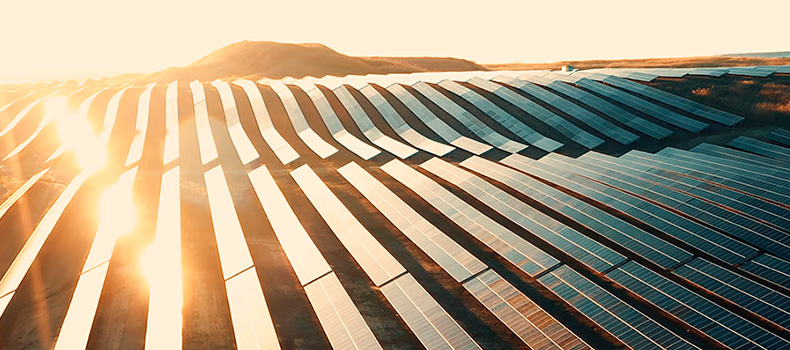
Grifols is committed to increasing the use of renewable energy, which already accounts for 56% of our total electricity consumption. The company has set a goal to source 100% of its electricity from renewable sources by 2030. This commitment includes the purchase of green energy and the promotion of new electricity generation facilities, complemented by renewable electricity supply contracts.
In our Energy Policy approved in 2023, we established eight key commitments to minimize energy demand and promote the use of renewable energy sources.
In addition, by 2030, the company aims to improve energy efficiency per unit of production by 15%, leveraging artificial intelligence (AI) as a key tool to achieve this goal.
We're optimizing our industrial processes by using more efficient equipment to refrigerate our production facilities, applying artificial intelligence to automate and control air conditioning systems and replacing refrigerant gases with natural ones that are more environmentally friendly.
of Grifols' total electricity
consumption is derived from renewable
energy sources (2025)
Grifols regularly assesses key assets to strengthen the resilience of its critical infrastructure. Measures include diversifying production sites, implementing contingency plans, using durable materials and designing facilities to withstand extreme weather like strong winds and flooding. In addition, when choosing new facility locations, Grifols prioritizes regions with lower exposure to natural hazards.
The company ensures its buildings and facilities are sustainably designed. Our corporate headquarters in Sant Cugat del Vallès, Barcelona (Spain); our Clayton, North Carolina (U.S.) office building and warehouse; and our Montreal (Canada) fractionation plant and albumin production plant are constructed and certified under the LEED (Leadership in Energy and Environmental Design) standards. In addition, our Clayton purification and filling plant and the fractionation plant are certified under the Green Globes standards.
Moreover, Grifols announced the construction of a new plant in Lliçà de Vall, Barcelona (Spain) – a 25-hectare biotechnology campus – that will be highly digitized and will integrate intelligent systems to measure and manage energy and water consumption, minimizing resource use and improving environmental traceability and incorporating circular economy initiatives.
Grifols recognizes water as a critical resource due to its role in production processes and its impact on product quality. We work to ensure the sustainable use of water resources, addressing all aspects related to water withdrawal, consumption and management.
We are committed to efficient water use and reducing environmental impact through initiatives such as optimizing water consumption in production plants, recycling and reusing water whenever possible, and managing water resources sustainably. We also work to implement practices that preserve water sources long-term, minimizing its water footprint.
Our approach to water stewardship is formalized in our Water Management Policy.
80%
of withdrawn water is returned to public wastewater systems (2025).
73%
of production is generated at facilities that have implemented water-saving measures (2025).
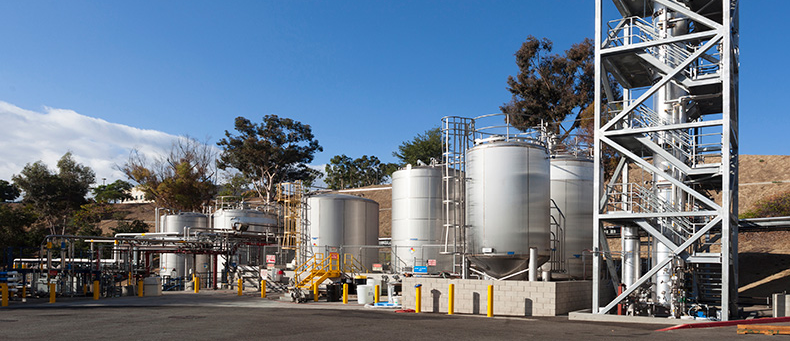
Through the application of eco-design and circular economy measures, we prioritize the efficient use of material resources and water and energy, as well as minimize waste and facilitate recovery, taking into account the different life-cycle stages of our products and services. Some of the most significant examples of our circular economy include eco-efficiency measures in all new projects, recycling and reusing ethanol in our production processes and reducing water consumption throughout production.
Grifols was the first pharma company in the U.S. to receive Zero Waste to Landfill UL validation. In 2025, the company’s North Carolina Biopharma industrial facilities maintained this validation for the seventh consecutive year, preventing 99% of waste from being sent to the landfill through recycling, composting, anaerobic digestion and other energy recovery techniques.
metric tons of waste recovered in 2025
(54% of the total waste generated)
In North Carolina (U.S.), Grifols owns more than 300 acres (121 hectares) of protected land adjacent to its production facilities, which includes eight walking trails and is home to more than 300 plant and animal species. The area has been granted GOLD conservation certification through the Wildlife Habitat Council (WHC) in recognition of our efforts to protect biodiversity through programs for bluebirds, bats and pollinators, among others.
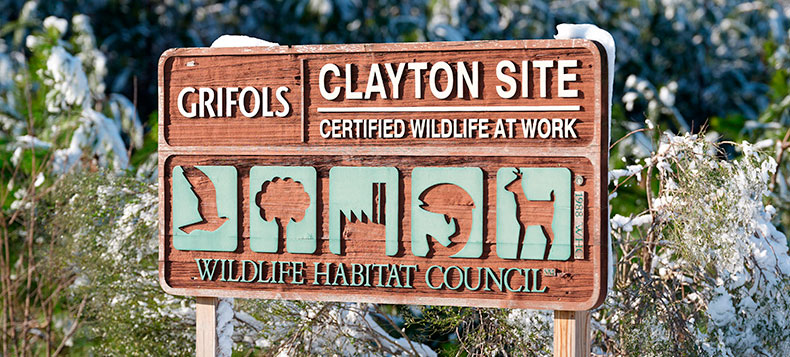
In Spain, through an agreement with the Rivus Foundation, we participated in a program to restore rivers, improve biodiversity and study mammals and fish in the Besòs riverbed. Read our Biodiversity Policy for further details.
Find out more about our environmental initiatives supported in our Social Action section and our Biodiversity Policy.
acres of forest preserved
equivalent to more than 150 soccer fields
Grifols established a corporate environmental management system based on the international ISO 14001 standard to monitor compliance with environmental regulations. This includes setting pollution-prevention measures and objectives for continuous improvement. Our 11 environmental committees worldwide ensure the correct implementation of the system and the enhancement of environmental performance.
By the end of 2025, 73% of Grifols’ total production was manufactured in ISO 14001-certified facilities, reflecting adherence to the highest environmental management standards.
Our corporate Environmental Policy and Energy Policy stress the importance of sustainable resource use and waste management through eco-efficiency and circular economy measures, as well as the reduction of atmospheric emissions. Grifols' environmental goals for 2023-2026 are defined in its Corporate Environmental Program.
Following the recommendations of the Task Force on Climate-related Financial Disclosures (TCFD) and the Corporate Sustainability Reporting Directive (CSRD), Grifols also reports the most relevant climate risks and opportunities related to its business (see report).
In addition, Grifols participates annually in the Carbon Disclosure Project (CDP), a program that evaluates corporate strategies and performance on climate change.
The company's broader sustainability efforts are highlighted in the Integrated and Sustainability Annual Report.
For more information, please contact us at medioambiente@grifols.com.

total resources allocated to environmental management in 2025,
including costs and investments. €183M in the last 3 years
Grifols' longstanding commitment to people and the planet entails helping society on all fronts by strengthening our positive social, economic and environmental impacts.